
There’s a particular thrill in standing before a Mark Rothko painting Mark Rothko was an American abstract painter. He is best known for his colour field paintings, depicting rectangles of different colours), that moment when your breath catches for reasons you can’t quite articulate. The same dizzying sensation arrives when reading a Mary Oliver poem about geese arrowing across the sky—both leave you fuller and emptier all at once. Her evocation is the canvas, her words the colours. This isn’t coincidence. Art and poetry aren’t just neighbors in the realm of creative expression; they’re conspirators, trading secrets in the hush between brushstrokes and line breaks.
So when does a painting stop being pigment on canvas and start humming like verse? When does a sculpture become a stanza in three dimensions? The answers lie in the spaces where these forms overlap—where they flirt, argue, and ultimately reveal their shared DNA.
The Weight of Absence
Poetry thrives in what’s unsaid. Consider the way a haiku’s power lives in the silence after the final syllable, or how Emily Dickinson’s dashes suggest more than they state. Visual art operates similarly—the most arresting works often speak loudest through omission, through what is being thought.
Edward Hopper’s Nighthawks is a masterclass in this. On the surface, it’s just a diner at night: a counter, four figures, and an expanse of empty street. But the real story pulses in the negative space—the aching distance between those hunched shoulders, the way the light spills onto the sidewalk like a question no one will answer. It’s a visual sonnet about urban loneliness, where every shadow is a line break.
Or take Hiroshi Sugimoto’s seascapes, those hypnotic horizons where water and sky dissolve into one another. They’re not really about the ocean. They’re about time itself—how it stretches and blurs, how it refuses to be pinned down, how it is a construct that juxtaposes nature. Like a poem that circles its subject without ever naming it, these photographs invite you to project your own longing onto their gauzy surfaces.
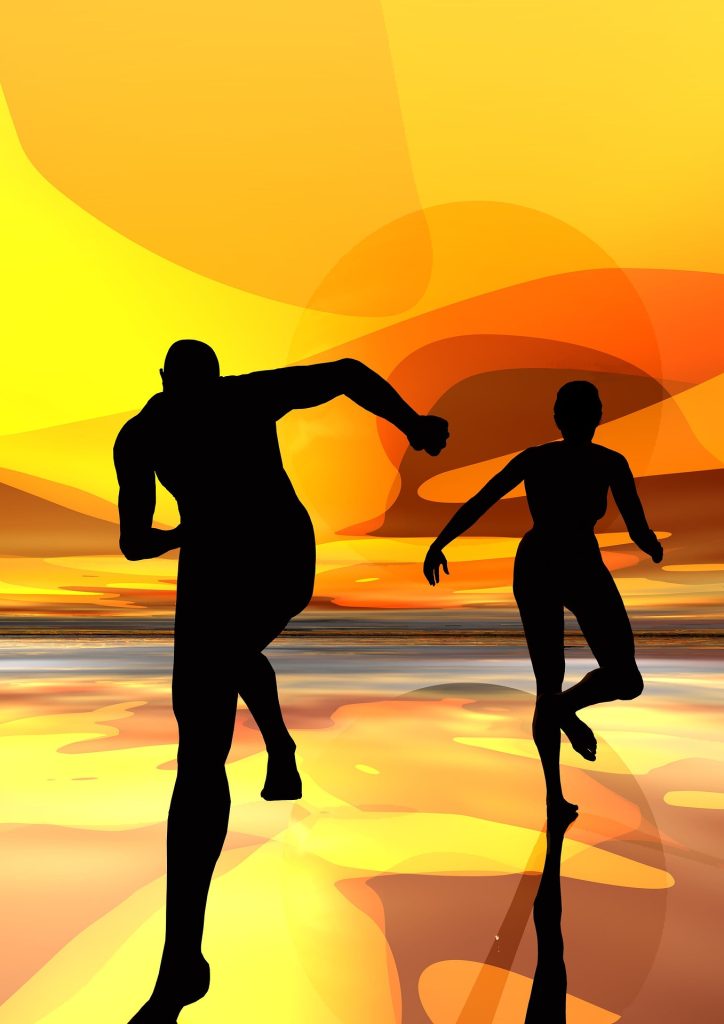
Even in abstraction, the principle holds. Agnes Martin’s delicate grids whisper rather than shout. Her pencil lines, faint as a poet’s pencil drafts, suggest an order so fragile it might evaporate if you stare too hard. You lean in, searching for meaning, and in that act of leaning, you become part of the work. Sometimes you have to decide what a piece means for you. Are the runners running away or running toward?
Rules Broken Beautifully
Every art form has its conventions. Poetry has meter and rhyme; painting has perspective and composition. But the magic happens when artists and poets take those rules—not just to follow them, but to crack them open and see what spills out, see what’s in between.
Picasso’s Weeping Woman series is cubism at its most visceral. Faces splintered into jagged planes, eyes mismatched and swimming with grief—it’s a visual scream that dismembers anatomy the way a modernist poem shatters syntax. The effect isn’t confusion, but a deeper truth: sorrow doesn’t arrange itself neatly and what does it look like when someone says, “I’m shattered…”
Then there’s Jean-Michel Basquiat, whose crown motifs repeat like a poet’s refrain. Scrawled over skeletal faces and fragmented text, those crowns aren’t just symbols; they’re incantations. Each recurrence twists the meaning—sometimes ironic, sometimes triumphant, always urgent. Like a villanelle’s circling lines, they gain power through repetition, becoming a kind of visual mantra.
And to a 20th century genius, there’s Duchamp’s Fountain, the ultimate cheeky rupture. By plunking a urinal into a gallery, he didn’t just mock art’s pretensions—he created a readymade haiku. Seventeen syllables’ worth of provocation: Here, this is art because I say so.
The Alchemy of Materials
Poets obsess over word choice—the heft of “stone” versus “rock,” the sibilance of “silken.” Visual artists wage the same wars with their mediums.Consider Anselm Kiefer’s lead books, their pages fused shut. They’re sculptures, yes, but also physical metaphors—what is a sealed book if not a poem that refuses to be read? The weight of the material becomes part of the meaning, just as a poet might select brittle paper for a chapbook about fragility.
Or take Kiki Smith’s Rapture, where the female figure emerges from a wolf’s belly in gleaming bronze. The metal’s permanence clashes gorgeously with the myth’s violence—a tension that recalls Sylvia Plath’s Ariel, where the body is both “white Godiva” and “arrow.” Both artists force their materials to confess contradictions.
Even in digital art, the principle holds. Refik Anadol’s AI-driven installations use data as pigment, transforming numbers into swirling, dreamlike visuals. It’s code as couplet, algorithms as alliteration—a reminder that poetry has always lived in patterns. They are grouped together as ‘The Arts’ because they have so much in common, rather than what separates them.
The Invitation to Dwell
Here’s the secret both art and poetry know: true engagement requires surrender. You can’t speed-read a poem any more than you can glance at a Joan Mitchell painting and “get it.” Both forms demand you linger, circle back, and let the work work on you.
Cy Twombly’s scribbled canvases are often dismissed as childish—until you stand before them and feel the fever beneath the scrawl. Those looping, frantic marks are the visual equivalent of Frank O’Hara’s breathless I do this, I do that poems—messy, urgent, and vibrating with life.
Similarly, Jenny Holzer’s LED installations—with their scrolling truisms like ABUSE OF POWER COMES AS NO SURPRISE—gain power the longer you watch. The words flash, fade, and return, a visual echo of poetic repetition. You leave with the phrases burned into your eyelids, the way a good line of verse sticks in your throat.
The Takeaway: Let Them Elope
Perhaps art and poetry were always meant to marry. They share a mission: to condense the ineffable into form, to make the invisible visceral. Whether it’s a Louise Bourgeois spider looming over you (a sonnet in steel) or a Richard Serra slab tilting precariously (a haiku in rust), the best visual art doesn’t just sit there—it speaks.
So next time a painting gives you that Rothko clutch, don’t panic. Lean in. You’re not just looking—you’re listening. And somewhere, in the space between pigment and page, a poet is nodding.
It is truly worthwhile when thinking of art for your home that you learn how to immerse yourself into a picture, like you do with a poem – after all, you’ll be looking at it for some time….
Please research these artists and poets mentioned – their works were chosen because they are so evocative. This is what you want from home art. Something that always gives you more.


